19. Openness-adjustable Headset
Openness-adjustable Headset: A Headset with Adjustable Openness
Please start with the demonstration video.
What is the Openness-adjustable Headset?
A new headset that physically adjusts how open it is to the outside air.
With this headset we propose new ways of listening to and expressing music, control over the environment for intellectual work, support for road safety, and support for perceiving the environment and communicating with others.
It is said that the eyes have lids but the ears do not. The Openness-adjustable Headset is, so to speak, a smart lid for the ears, connected to the internet.
Letting the user, collective intelligence or artificial intelligence control the opening and closing extends human hearing and sociality.
Headsets today come in closed types that cover the ears, open types that deliberately admit outside air, and, as a kind of open type, bone-conduction types that convey sound by direct vibration. Their characteristics are:
- Shutting out the outside world lets you immerse yourself in the sound environment being produced.
- Admitting the sound of the outside world creates a distinctive sound environment.
- Perceiving the sounds of the outside world at the same time helps with communication and road safety.
These characteristics, however, come from the physical structure of the headset and cannot be changed.
We therefore developed a headset with a mechanism that can transform between closed and open types under motor control.
This lets the user actively choose among the characteristics above.
How it works
Using the physical computing toolkit konashi, commands from a smartphone control servo motors wirelessly to open and close the headset. It works with an Arduino as well, of course.
The hardware was made by taking apart a commercial pair of headphones and combining it with moving parts printed on a 3D printer. Sound is produced by a bone-conduction speaker connected over Bluetooth.
The software was written on jsdo.it. Microsoft Azure is used as the Node.js server. Some parts are written in Java.
Scenarios of use (shown in the demonstration video above)
- 新しい音楽鑑賞体験
- Songle Widgetを活用し、Songle.jpに登録されているおよそ10万曲もの楽曲から好きなものを選んで、サビの時に自動的に開閉することで没入感や爽快感を高められます。ソースはこちらにあります。
- 知的生産活動支援
- カフェの喧騒が好きな人や図書館の静寂が好きな人など、知的生産活動に適する環境は人それぞれです。私の場合は最初はカフェがよいのですが、集中してくると静寂を求めたくなります。そこでタイマー仕掛けでだんだん開放度が小さくなるようにすると、スムーズに音環境を移行できます。ソースはこちらにあります。
- 交通安全支援
- ヘッドフォンをしたまま自転車に乗ると道路交通法に問われる時代になりました。本機能を用いれば、スマートフォンのセンサにより高速移動を検知した場合に自動的にヘッドセットが開放状態になります。うっかり自転車に乗ってしまう方におすすめします。ソースはこちらにあります。 スマートフォンの加速度センサをそのまま使う方式と、ドコモの動作推定APIを使う方式を併用します。
Playful scenarios of use
- 環境認知支援、コミュニケーション支援
- 日本エヴィクサー株式会社のテレビチャンネル認識SDKと組み合わせて、絶対聞きたくないテレビ放送を認識するとヘッドセッドが閉じます。たとえばNHKが嫌いな方なら、町中でNHK放送が聞こえてくるとヘッドセットが閉じるようにできます。
- Gracenote楽曲認識モバイルクライアントと組み合わせて、予め登録した特定の音楽が町中で流れていたら、ヘッドセットを開閉して聞き耳を立てたり、聞かないようにしたりできます。
- ドコモの音声認識APIを活用
- It opens automatically when someone speaks to you or calls your name.
- It opens automatically when it recognizes a keyword you have registered as being of interest. For instance, even while you are concentrating on work with the headset closed, if people nearby are talking about a performer you like, it can open so that you can listen in.
- It closes automatically when it recognizes a keyword you have registered as unwanted. For instance, while talking with someone, if you do not want to hear the result of a World Cup match, it can close in response to the words "World Cup".
- 発言権に時間制限を与える
- 会議支援。参加者全員が提案ヘッドセットを装着します。誰かが発言するたびにタイマーをセットし、時間制限を超えると全員のヘッドセットを閉鎖状態にします。「だれもあなたの発言は聞こえませんよ!」という無言の圧力を与えられることでしょう。 ある意味自衛的なSpeechJammerといえましょう。

- 告白タイム支援。このマンガのように、軟弱な男子に「大事な話がある」と言われたら、「10秒だけ時間をあげるわ」とクールにタイマーを起動させるのです。どうせそのような男子は10秒では意味のある発言はしないでしょう。10秒後、冷酷にヘッドセットは閉鎖。「さよなら。」呆然としている男子を横目に、あなたは颯爽とその場を去るのです。

It is a common complaint that taxi drivers and hairdressers talk to you more than you would like.
Since ancient times, covering both ears with your hands has carried not only the meaning "I do not want to hear this" but also a pleading nuance of "please stop." With the proposed system, we can instead take a firm stance toward those who would reach our hearing, and declare that they are not entitled to it.

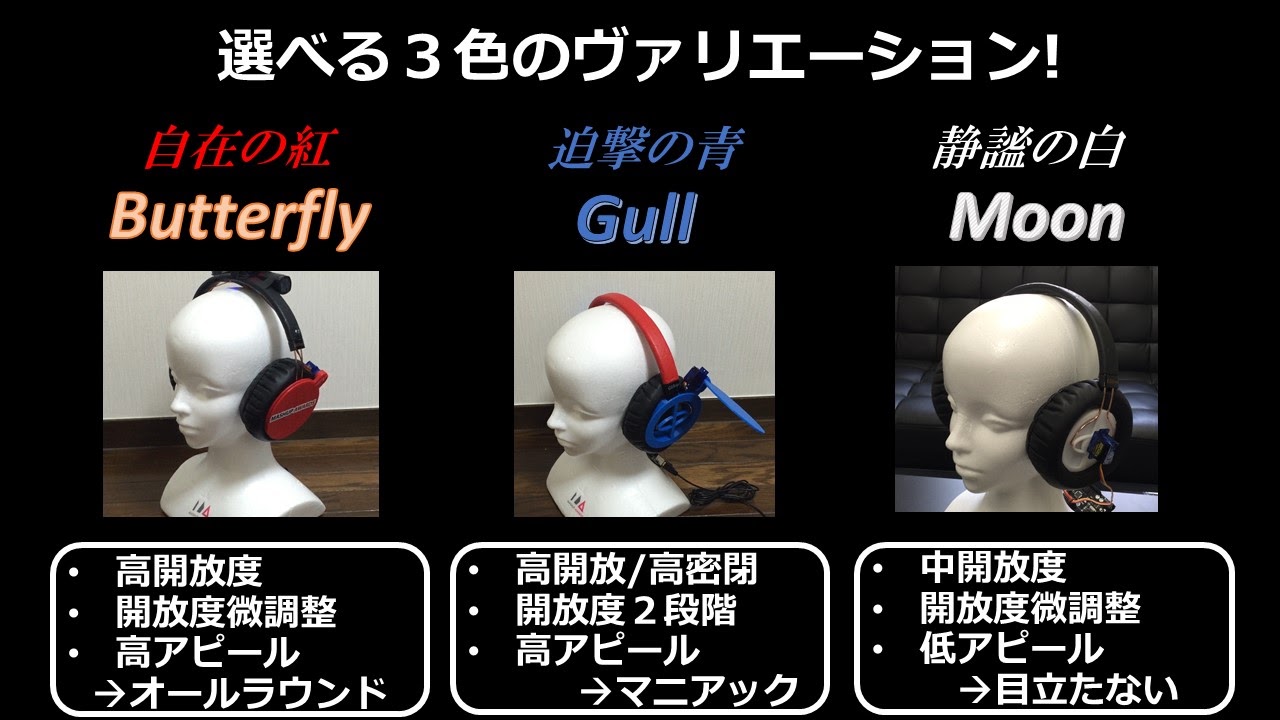
Variations
Butterfly
A window slides open and shut on the outside. This is the one used in the demonstration video. The degree of openness can be controlled finely, and it is easy to see.
Gull
A model with a gull-wing mechanism. It has only two states, closed and open, but it can be sealed more tightly when closed. It is also easy to see.
Moon
A version in which the mechanism is less conspicuous. It opens and closes through 180 degrees, like a fan.
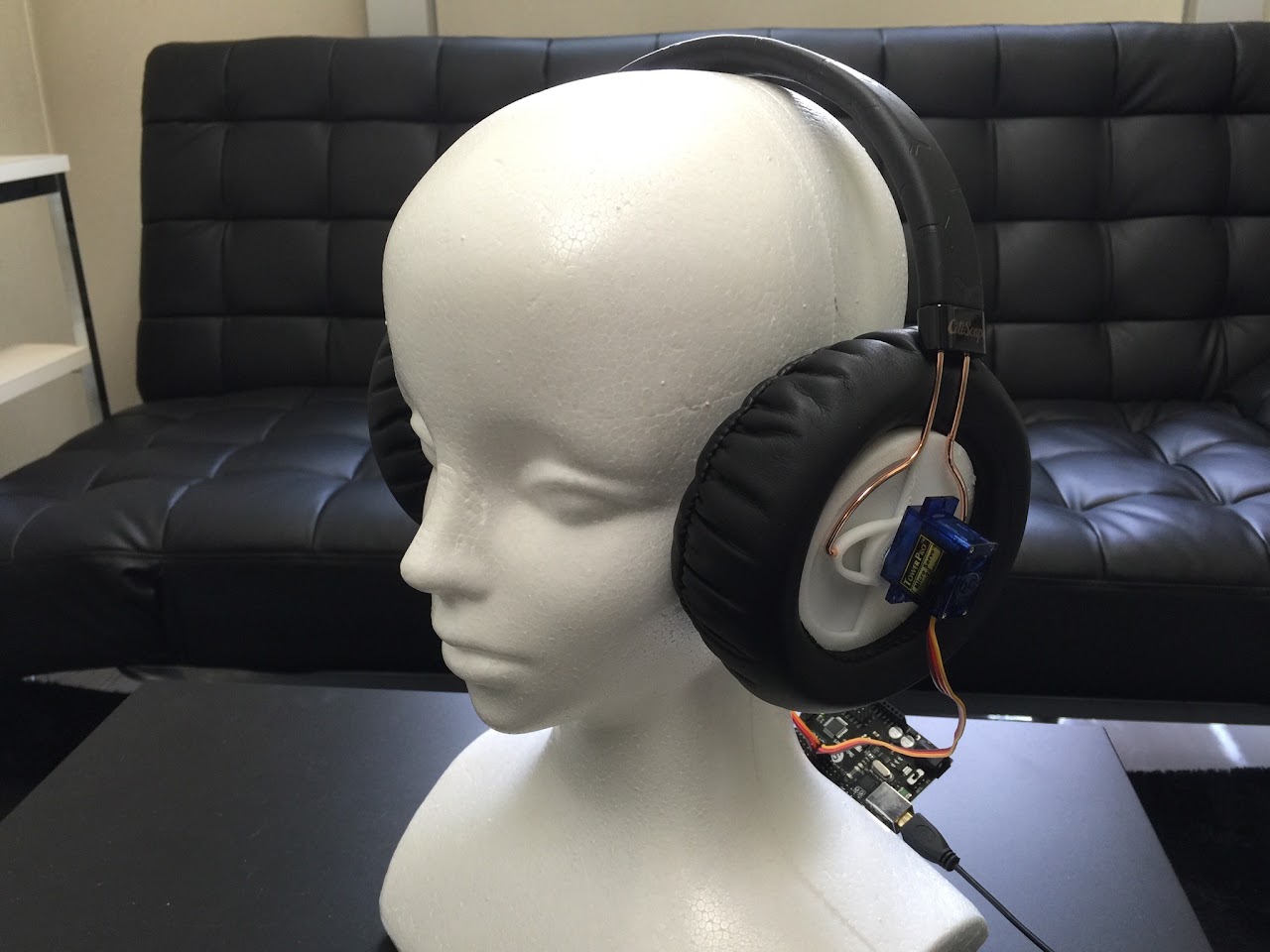
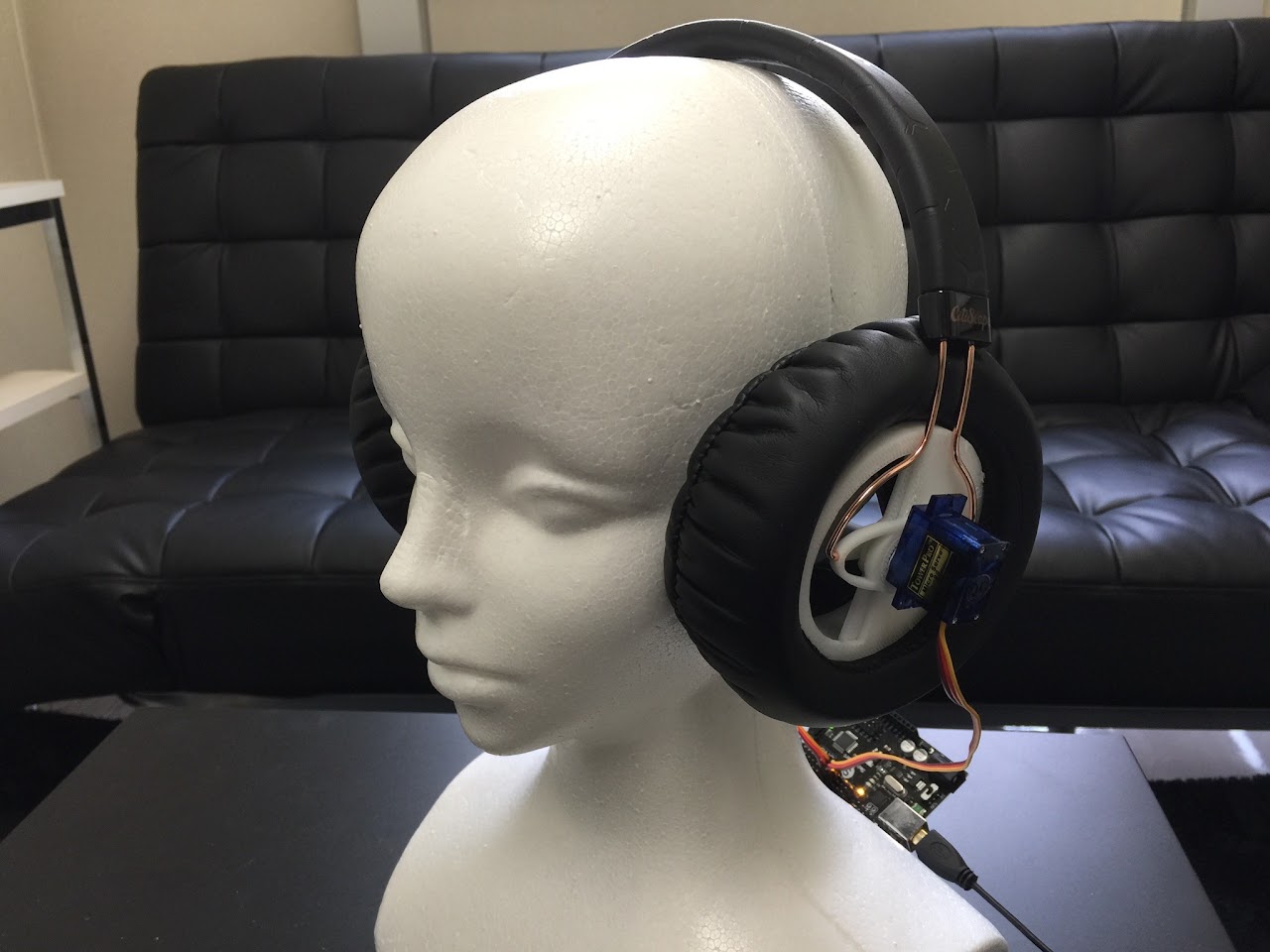
Being inconspicuous is good in itself, but one theme of this work is to design something that makes it obvious, from the outside, whether this person is likely to hear you if you speak to them. On that point Moon falls a little short.
For the demonstration video too, Butterfly conveys the change in openness to the viewer better than Moon, so that is the one we used.
What we would like to do next
Above all, the present prototype has its hardware exposed, so we would like to redesign it to look better. The software is equally bare, so design is a challenge there too.
Related products
Here Active Listening, which has recently appeared on Kickstarter to raise funds, is an earplug-shaped device: it picks up the sound of the outside world with a microphone, processes it in real time into the sound the user prefers, and plays it back to them.
- An article about it (in Japanese): http://techable.jp/archives/26450
- Kickstarterのページ: https://www.kickstarter.com/projects/dopplerlabs/here-active-listening-change-the-way-you-hear-the
That such a system draws attention shows the promise of products that consider how to combine the sound of the outside world with artificial sound such as the music the user wants to hear. Two differences between Here Active Listening and our system are worth emphasizing.
- Here Active Listening keeps a device in the ear at all times and adjusts the sound by signal processing, whereas our system adjusts it mechanically, and when giving an open sound it aims for a mechanism in which nothing touches the inside of the ear. This is because we believe that the touch and the sense of warmth and cold that the ear feels in direct contact with the world, and the delay that comes with signal processing, also affect how sound and the environment are perceived.
- The other difference is that, for supporting communication, we consider it important to disclose one's inner state: that one is able to hear the outside world. Our system deliberately shows the other person, visually, whether the ears are covered by headphones, whereas Here Active Listening looks like an earplug.
The recently revised Road Traffic Act has also stirred debate about the danger of wearing headphones while cycling and the safety of physically open mechanisms such as bone-conduction headsets. We hope that our system, which can be physically opened, whose state others can see, and which can be opened or closed as the situation requires, will contribute something to that debate.
(c) Kazutaka Kurihara

(c) Kazutaka Kurihara