Research on Horse Racing
Betting Behavior and the Favorite-Longshot Bias in the Pari-mutuel System
The pari-mutuel system, used in horse and bicycle racing, pools all the money that is bet and divides it among those who picked the winner. Because the payout falls as more money is placed on an entrant, the odds come to reflect the collective forecast of everyone who has bet.
Those odds, however, are known to carry a long-standing distortion called the favorite-longshot bias. Longshots win less often than their odds suggest, while favorites win more often than theirs.
Together with Yohei Tutiya, I have been investigating how this distortion arises, using data from actual races and a mathematical model that simplifies the behavior of bettors.
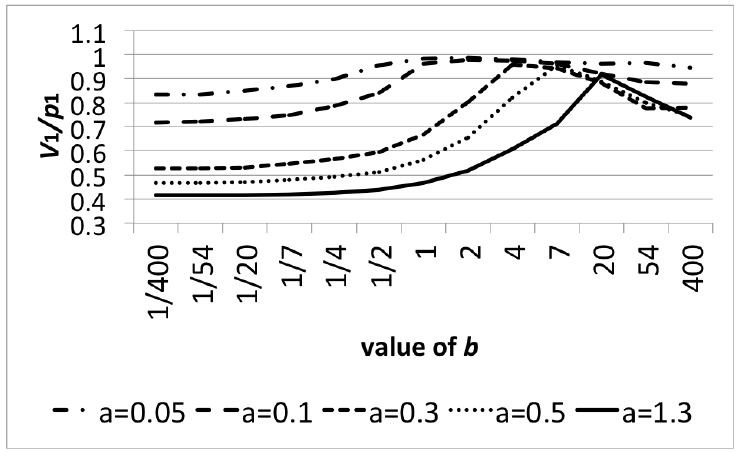
We reproduced the distribution of odds in simulation under two assumptions: that bets rush in as the deadline approaches, and that each bettor picks the entrant with the largest expected return. The result is that the favorite-longshot bias does not disappear even when every bettor behaves efficiently in this sense, and that it can even grow stronger. The figure above shows how the strength of the bias changes as the spread of the bettors' forecasts is varied. Values below 1 on the vertical axis indicate that the bias is present.
Papers
Kazutaka Kurihara and Yohei Tutiya: "Efficient Micro-Behaviors in Pari-mutuel Betting System and FL Bias," Journal of Gambling Business and Economics, Vol.14, No.2, pp.17-29, 2021. Site
Yohei Tutiya and Kazutaka Kurihara: "Parimutuel System of the Japanese Race Track: Voting and Ranking Process," Journal of Gambling Business and Economics, Vol.9, No.2, pp.27-39, 2015. Site
Kazutaka Kurihara and Yohei Tutiya: "Efficiency in Micro-Behaviors and FL Bias," arXiv:1805.04225, May 2018. arXiv
(c) Kazutaka Kurihara